
Gym and lifting shoulder pain, Inner West
Bench, overhead press, dips and the catch position. What is actually going on, and how to keep training while it settles.
Almost nobody who lifts wants to be told to stop lifting, and almost nobody needs to be. Most gym shoulders are a load problem rather than damage: a program that added volume faster than the tissue adapted, a return after a break at the weight you finished on, or one exercise that a particular shoulder does not tolerate at a particular range.
The useful questions are which movement provokes it, at what part of the range, and what changed in the four to six weeks before it started. That is usually enough to get a working answer, and it is usually enough to find something you can still train.
We treat lifters, CrossFit athletes, Olympic lifters and general gym goers, and we have a full gym floor here, which means the rehab happens with the bar in your hands rather than with a theraband in a cubicle.

The lifts that cause it
Four patterns cover the great majority of gym shoulders.
Bench press
Pain at the bottom of the press, or right on the top of the shoulder at lockout. The first often relates to the front of the shoulder and how far the elbow travels behind the body; the second usually points at the AC joint. Grip width, bar path and range are all worth examining before anything gets dropped.
Overhead press and the catch
Pain pressing overhead, or in the catch position of a snatch or a jerk. Often about the range available through the mid back and shoulder blade as much as the shoulder itself, because a shoulder that cannot get overhead will find the range somewhere it should not.
Dips and deep pressing
Pain through the front of the shoulder at depth. Very often a range and load combination rather than an injury, and often manageable by changing the depth for a period rather than removing the movement.
The volume spike
No single lift, just an ache that arrived after a new program, a new class, or coming back after a layoff. This is the commonest one, and it is the one that resolves most predictably once the load is managed properly.
Physios who train and program
You can choose who you see when you book.

Kevin Wong
Accredited Exercise Physiologist and Senior Physiotherapist
Dual qualified as a physiotherapist and an Accredited Exercise Physiologist, blending hands-on treatment with exercise medicine. His stated approach is to keep you active while recovering rather than resorting to complete rest, which is exactly the question most lifters are asking.
AHPRA PHY0002255886
ESSA #22370

Prak Sharma
High Performance Physiotherapist and ASCA Level 1 Coach
An ASCA accredited Level 1 Strength and Conditioning Coach as well as a physiotherapist, with experience delivering strength and conditioning programs in high performance environments, so the way back to full load is programmed rather than guessed.
AHPRA PHY0002909388

Aila Darabi
High Performance Physiotherapist
Trains in the gym herself and has worked through her own injuries across gym training, tennis, touch football and running.
AHPRA PHY0004038031
Training through it, properly
The first appointment works out what the shoulder currently tolerates. That is the level we train at while capacity is rebuilt, and it is almost never zero.
What usually changes in your program
- The provoking lift is modified rather than removed, most often by changing range, grip or tempo
- Everything that does not hurt keeps going, including lower body and most pulling work
- Cuff and shoulder blade strength is added as real loaded work, not as a warm-up afterthought
- Load is stepped back up on a written plan, so the increase is deliberate
We measure the shoulder
Rotation strength is tested on a force frame so both sides come back as numbers, and grip and limb strength testing is available here too. On a lifter that matters because the perception of strength is dominated by the big lifts, and the cuff can be well behind while the bench is fine.
When it is not just load
A small number of gym shoulders are structural: a labral injury from a heavy catch, a cuff tear in an older lifter, an AC joint that has taken years of pressing. We will say so, and we will tell you if an opinion from a surgeon is worth getting.
Pressing variations we actually program
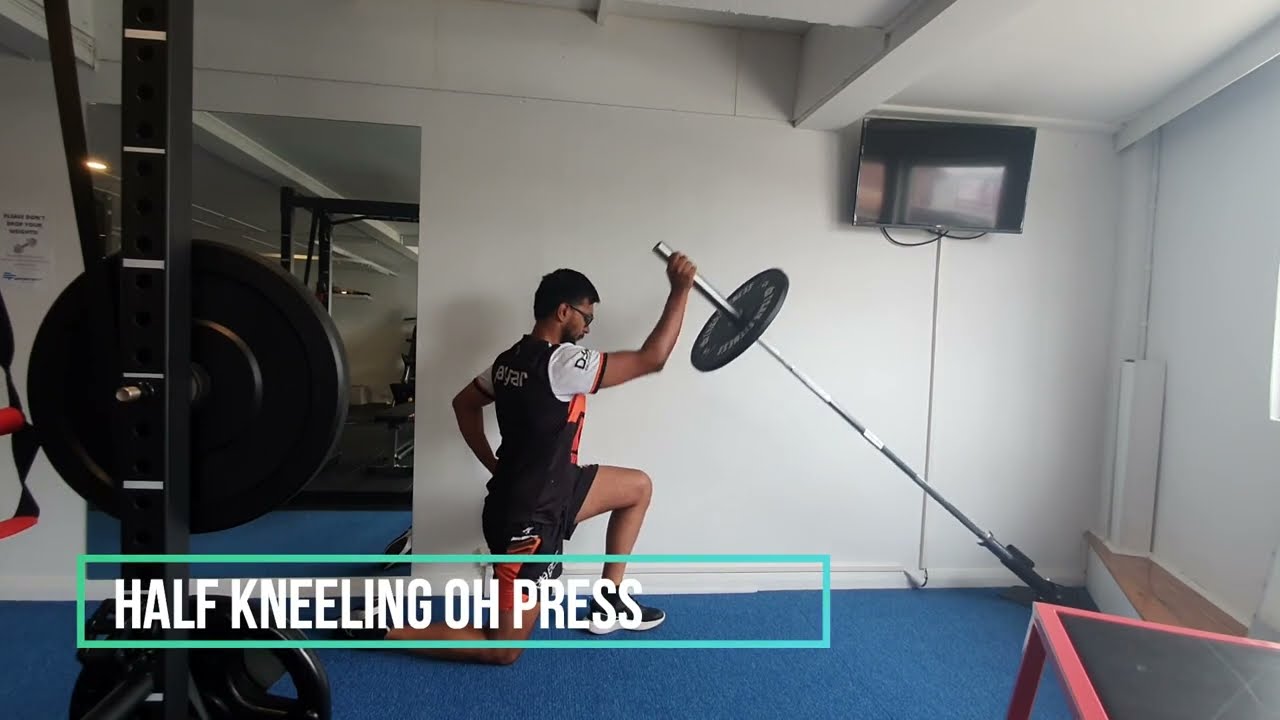
Half-kneeling, standing, push press and jerk variations on the landmine, which is usually where overhead pressing comes back first.
Questions we get asked
Do I have to stop benching?
It only hurts overhead. Is that a rotator cuff tear?
Should I get a scan?
Shoulder stopping you pressing?
Book a free 30 minute call. We will tell you what is likely going on and what you can keep training in the meantime.
No gap on an accepted claim · You choose your own physio · Five Dock